

The new ISO 9001:2015 standard introduces the term “knowledge.” As knowledge was not addressed by the previous ISO 9001 standard, the depth of this topic and the approach to it are new. ISO 9001:2015 defines requirements for the handling of organizational knowledge in the following four phases, which are analogous to the PDCA cycle:
- Determine the knowledge necessary for the operation of processes and for achieving conformity of products and services
- Maintain knowledge and make it available to the extent necessary
- Consider the current organizational knowledge and compare it to changing needs and trends
- Acquire the necessary additional knowledge.
By introducing the term “knowledge,” ISO 9001:2015 aims to raise organizations’ awareness of the management and linking of know-how in order to position them for the future. The four phases that define the requirements for handling organizational knowledge include various focal and starting points that provide guidance for organizations. Establishing knowledge and competence goals at the start of the process, for example, makes good sense. To do so, organizations should, for instance, determine knowledge of customer expectations and requirements and of particular production and service-provision processes. Subsequently, they can plan how they can achieve the identified goals and objectives by means of training, learning on the job, or e-learning. In phase 2, the organizations should determine specific methods to exchange knowledge in-house and to maintain this knowledge. Possibilities include employees passing on their experience from completed projects or failures to their colleagues in the style of “lessons learned.” Employees leaving the company or refusing to share their experience and know-how represent a major risk of loss of knowledge. Organizations wishing to avoid these risks can collect and maintain the available know-how. In phase 3 the organization must evaluate new knowledge, such as that communicated in training, interview employees on their status of knowledge where appropriate, and identify opportunities for improvement. Another major challenge involves monitoring changes in the market or in technology and analyzing the extent to which they influence the knowledge that the organization requires. Once the organization identifies opportunities for improvement in certain areas, targeted measures should be taken in phase four. Depending on the individual situation, companies may further enhance their relations with clients, suppliers, and service providers or improve their mechanisms for keeping their organizational knowledge secure. It may prove a good idea, for example, to renew the validity of functions critical for knowledge or to improve the protection of existing know-how by filing patents. In addition to continued in-house training, organizations can also use external sources including newsletters, specialist magazines, memberships in associations, or important partnerships to expand their knowledge. By introducing the subject of organizational knowledge, the new ISO 9001:2015 standard raises organizations’ awareness of sustainable and future-oriented success factors.
Clause 7.1.6. Organizational Knowledge
The organization should determine the knowledge necessary for the operation of its processes and achieve conformity of products and services. This knowledge shall be maintained and made available to the extent necessary. When addressing changing needs and trends, the organization shall consider its current knowledge and determine how to acquire or access any necessary additional knowledge and required updates. Organizational knowledge is knowledge specific to the organization; it is generally gained by experience. It is information that is used and shared to achieve the organization’s objectives. Organizational knowledge can be based on: a) Internal Sources (e.g., intellectual property, the knowledge gained from experience, lessons learned from failures and successful projects, capturing and sharing undocumented knowledge and experience; the results of improvements in processes, products, and services); b) External Sources (e.g., standards, academia, conferences, gathering knowledge from customers or external providers).
The organization shall determine the knowledge necessary for the operation of its processes and to achieve conformity of products and services. Organizations should have a system for determining, collecting, and making available meaningful data for the operation of its processes to achieve conformity of its products and services. The process for considering and controlling past, existing and additional knowledge needs to take account of the organization’s context, including its size and complexity, the risks and opportunities it needs to address, and the need for accessibility of knowledge. The balance between knowledge held by competent people and knowledge made available by other means is at the discretion of the organization, provided that conformity of products and services can be achieved. In Annex A.7 of ISO 9001:2015, it is clearly mentioned that there is a need to determine and manage the knowledge maintained by the organization, to ensure that the operation of its processes and can achieve conformity of products and services. Requirements regarding organizational knowledge were introduced so as to safeguard the organization from loss of knowledge which may occur due to staff turnover; failure to capture and share information; Also the standard wanted to encourage the organization to acquire knowledge by learning from experience, mentoring, benchmarking, etc
Firstly we need to realize that this new clause is not a Knowledge Management standard, nor does it require an organization to have Knowledge Management in place as a formal requirement. It is a clause in a Quality standard and requires that sufficient attention is paid to knowledge to ensure the good and consistent quality of goods and services. To comply, however, an organization needs to have many Knowledge Management elements operating (as opposed to planned) as part of the Quality Management system. Thus there has to be an appropriate system for learning from experience, including lesson learning. There has to be an appropriate approach to knowledge retention, including mentoring, tacit knowledge capture, and knowledge sharing; There has to be some form of Organizational knowledge audit, Organizational knowledge benchmarking, and Organizational knowledge strategy, sufficient to identify the critical knowledge needed to deliver quality products and services, and the main knowledge gaps. There has to be a system (roles, processes, and supporting technology) for maintaining knowledge and making it available to the extent necessary.
We do not yet know how clause 7.1.6 will be audited, but the auditors may be looking for evidence that the following are in place: The organization may need to have “determined the knowledge necessary” for the operation of processes and to achieve conformity of products and services. One may, therefore, conduct a knowledge scan of key knowledge topics, and create a critical knowledge list. The knowledge needs to be “maintained”. Each critical knowledge topic can have a topic owner, and an appropriate maintenance procedure. The knowledge needs to be “made available”. There needs at the very least to be an effective way to find the knowledge, such as a good knowledge base and search engine. Even better if the knowledge is “pushed” to those who need it. There can be a strategic knowledge plan, with identified actions to fill knowledge gaps from external sources. There can be an effective system for learning from experience and for lesson learning, including embedded roles, consistent lesson capture processes, a lessons management system, and good governance. This system should also cover lessons from process, product, and service improvements. There should be a Knowledge Retention and Transfer program.
Example of Organizational knowledge
| 7.1.6 Requirements | Organization: Large 24-hour food retailer Process location: 9 food checkout counters Process:‘Food checkout’ |
| 1. What knowledge is necessary here? | Security protocols for handling/retaining customer money in the counter cash box, operation of a bar code reader, operation of moving food belt, suspect theft protocols, getting help, keying in discounts and food codes, customer food packing, abuse/violence protocols, credit/debit card payments, cashback. |
| 2. How is this knowledge maintained within the organization? | All protocols and activities above are maintained in documented information by the Quality Manager with Human Resource (HR) assistance. |
| 3. How is it made available? | Through the organization’s intranet portal, and available to all persons working for it, to the extent necessary. Also contained in hard copy format at each checkout counter (version and distribution controlled). Also made available through the shift managers. |
| 4. Are there any changing needs/trends? | Yes, promotion codes sold by other retailers that add points to a customer’s rewards card (incentives schemes). |
| 5. Is any additional knowledge required for (4.)? How is this to be acquired/ accessed? | Yes, how to scan these codes in to add points to their reward card, and give a rewards discount on purchases made. IT Systems workforce is to train and write instructions to be included in the documented information above. |
| 6 Required updates? | Frequent, as promotion codes change monthly. Suggest a monthly check on changes/knowledge needed. |
Example of Organizational knowledge for process “food Checkout”
Knowledge in Organizational Knowledge
In everyday language, we use knowledge all the time. Sometimes we mean know-how, while other times we are talking about wisdom. On many occasions, we even use it to refer to information. Part of the difficulty of defining knowledge arises from its relationship to two other concepts, namely data and information. These two terms are often regarded as lower denominations of knowledge, but the exact relationship varies greatly from one example to another. Within more technologically oriented disciplines – particularly involving information systems – knowledge is often treated very similarly to information. It is seen as something one can codify and transmit, and where IT plays a pivotal role in knowledge sharing. For instance, the encyclopedia at fact-archive.com defines it as: “information that has a purpose or use.” This kind of simplistic view of knowledge was particularly widespread during the 90s when information technology became increasingly more common. To illustrate, Theirauf defines the three components as follows: data is the lowest point, an unstructured collection of facts and figures; information is the next level, and it is regarded as structured data; finally, knowledge is defined as “information about information”. However, increasingly one sees definitions that treat knowledge as a more complex and personal concept that incorporates more than just information. The Longman online dictionary states “the information, skills, and understanding that you have gained through learning or experience.” Although still closely associated with information, concepts like skills, understanding, and experience begin to surface.


1.) Data
The basic element of information in an organization is in the form of data. Organizations collect, summarise and analyze this data to identify patterns and trends. Most of the data thus collected is associated with the functional processes of the organization. Data are facts and figures which relay something specific, but which are not organized in any way and which provide no further information regarding patterns, context, etc. Thus Data can be defined as “unstructured facts and figures that have the least impact on the typical manager.”
2. Information
Each data element is a component of a transaction and does not provide much information unless it is presented in conjunction with other data elements. The accumulation of data into a meaningful context provides information. For data to become information, it must be contextualized, categorized, calculated, and condensed. The information thus paints a bigger picture; it is data with relevance and purpose. It may convey a trend in the environment, or perhaps indicate a pattern of sales for a given period of time. Essentially information is found “in answers to questions that begin with such words as who, what, where, when, and how many”
3. Analytic
The information gathered in the previous stage, although provides much insight, separating or regrouping this information and analysis extends the value of the information. Applications with analytical processing capabilities provide users with the ability to analyze information and determine relationships, patterns.
4. Knowledge
Knowledge is different from data, information or analytics in that it can be created from any one of those layers or it can be created from existing knowledge using logical inferences. Knowledge is closely linked to doing and implies know-how and understanding. The knowledge possessed by each individual is a product of his experience and encompasses the norms by which he evaluates new inputs from his surroundings. Knowledge can be defined as “Knowledge is a fluid mix of framed experience, values, contextual information, expert insight, and grounded intuition that provides an environment and framework for evaluating and incorporating new experiences and information. It originates and is applied in the mind of the knowers. In organizations, it often becomes embedded not only in documents or repositories but also in organizational routines, practices, and norms.”
5. Wisdom
Wisdom is the utilization of accumulated knowledge to create a higher level of understanding of the data. An example would help in understanding the distinction better. Mere numerals like 41, 42 are termed as data. This data, if read in the context of temperature would give an indication of the weather in that part of the world. The fact that these numbers indicate the temperature is information. Knowledge refers to the understanding that this temperature indicates summer. The decision to venture out or not in this weather or an understanding of the effects of this weather is wisdom.
Types of knowledge
Within business, two types of knowledge are usually defined, namely explicit and tacit knowledge. The former refers to codified knowledge, such as that found in documents, while the latter refers to noncodified and often personal/experience-based knowledge. Explicit Knowledge is the type of knowledge that is formalized and codified and is sometimes referred to like know what. It is therefore fairly easy to identify, store, and retrieve. This is the type of knowledge most easily handled by the organization, which is very effective at facilitating the storage, retrieval, and modification of documents and texts. From a managerial perspective, the greatest challenge with explicit knowledge is similar to information. It involves ensuring that people have access to what they need; that important knowledge is stored; and that the knowledge is reviewed, updated, or discarded. Explicit knowledge is found in databases, memos, notes, documents, etc. Tacit Knowledge is the type of knowledge that is sometimes referred to as know-how and refers to intuitive, hard-to-define knowledge that is largely experience-based. Because of this, tacit knowledge is often context-dependent and personal in nature. It is hard to communicate and deeply rooted in action, commitment, and involvement. Tacit knowledge is also regarded as being the most valuable source of knowledge, and the most likely to lead to breakthroughs in the organization. Gamble & Blackwell link the lack of focus on tacit knowledge directly to the reduced capacity for innovation and sustained competitiveness imagine trying to write an article that would accurately convey how one reads facial expressions. It should be quite apparent that it would be near impossible to convey our intuitive understanding gathered from years of experience and practice. Virtually all practitioners rely on this type of knowledge. An IT specialist, for example, will troubleshoot a problem based on his experience and intuition. It would be very difficult for him to codify his knowledge into a document that could convey his know-how to a beginner. This is one reason why experience in a particular field is so highly regarded in the job market. Tacit knowledge is found in the minds of human stakeholders. It includes cultural beliefs, values, attitudes, mental models, etc. as well as skills, capabilities, and expertise.
Modern Authors have classified Knowledge as follows:


Organizational Knowledge Resources
Business knowledge can exist on several different levels:
- Individual: Personal, often tacit knowledge/know-how of some sort. It can also be explicit, but it must be individual in nature, e.g. a private notebook.
- Groups/community: Knowledge held in groups but not shared with the rest of the organization. Companies usually consist of communities (most often informally created) which are linked together by common practice. These communities of practice may share common values, language, procedures, know-how, etc. They are a source of learning and a repository for tacit, explicit, and other types of knowledge.
- Structural: Knowledge found in processes, culture, etc. This may be understood by many or very few members of the organization. E.g. the knowledge in the routines used by the army may not be known by the soldiers who follow these routines. At times, structural knowledge may be the remnant of past, otherwise, long-forgotten lessons, where the knowledge of this lesson exists exclusively in the process itself.
Organizational knowledge is defined as: “all the knowledge resources within an organization that can be realistically tapped by that organization. It can, therefore, reside in individuals and groups, or exist at the organizational level.”
Extra-organizational: Defined here as Knowledge resources existing outside the organization which could be used to enhance the performance of the organization. They include explicit elements like publications, as well as tacit elements found in communities of practice that span beyond the organization’s borders.
Organizational Memory
Traditional memory is associated with the individual’s ability to acquire, retain, and retrieve knowledge. Within business, this concept is extended beyond the individual, and organizational memory, therefore, refers to the collective ability to store and retrieve knowledge and information. So how does one define organizational memory? Any definition would need to span all the different repositories in which a company may store knowledge. This includes more formal records, as well as tacit and embedded knowledge in people, organizational culture, and processes. Walsh and Ungson define a number of stages in the organizational memory process and outline five retention facilities:
1.Acquisition: Organizational memory consists of the accumulated information regarding past decisions. This information is not centrally stored, but rather it is split across different retention facilities. Each time a decision is made and the consequences are evaluated, some information is added to the organizational memory.
2. Retention: Past experiences can be retained in any of the five different repositories:
- Individuals
- Culture: The language and frameworks that exist within an organization and form shared interpretations.
- Transformations: The procedures and formalized systems that the organization employs. These systems reflect the firm’s past experiences and are repositories for embedded knowledge.
- Structures: These link the individual to other individuals and to the environment. Social interaction is conditioned by mutual expectations between individuals based on their roles within the organization. The interaction sequences for a pattern over time and begins to extend to an organizational level. This can take place both through formal and informal structure and it constitutes a social memory which stores information about an organization’s perception of the environment.
- External activities: The surroundings of the organization where knowledge and information can be stored. E.g. former employees, government bodies, competitors, etc.
- Retrieval: This can either be controlled or automatic. The latter refers to the intuitive and essentially effortless process of accessing organizational memory, usually as part of an established sequence of action. Controlled refers to the deliberate attempt to access stored knowledge.
As one can see, the three stages presented here are essential to the learning process of the firm. Much like an individual, the firm must be able to access and use past experiences so as to avoid repeating mistakes and to exploit valuable knowledge. Unlike an individual, however, Organizational knowledge is not centrally stored and resides throughout the firm and even beyond it. The process of retrieving knowledge/information will inevitably vary depending on the retention facility that one is trying to access. For example, written documentation may be accessed through IT while cultural memory is accessed through the understanding and/or application of the norms and procedures of the working environment.
A further distinction regarding the type of knowledge retained in the organization is offered by Ramage and Reif. They separate the documented aspects from the more subtle knowledge that belongs to individuals as a result of their role as members of the organization:
- Artefacts of Cooperation: These are the hard indicators that are visible and can be examined. They include products, records of collaboration, and ideas. The latter refers to minutes of meetings, reports, FAQs, and other items that record common knowledge. These are easily storable and presumably also more easily accessible.
- Knowledge of the Organization: This type of knowledge cannot be stored in the same way as the artefacts of cooperation. It includes knowledge of the political system, of the culture, and of how things are normally done within the firm. It can include the knowledge of who is an expert, of where a particular person is, and who to contact for a specific problem.
This definition is useful as a way of understanding the knowledge categories and the potential management challenge that organizational memory would pose. Furthermore one finds a distinct difference in the way organizational memory is perceived between IT practitioners and business theoreticians. The IT path emphasizes the acquisition and storage of organizational knowledge including data warehousing, document management, and search tools. The organization development (OD) path emphasizes tacit knowledge, coaching, social interactions, and encouraging ad hoc knowledge exchange. IT-based models thus tend to focus on more concrete, definable memory and less on people, culture, and informal structures. Essentially, they focus more on artifacts of cooperation.
Organizational Learning
Learning is the way we create new knowledge and improve ourselves. Botha et al. describe the organizational learning process as follows:

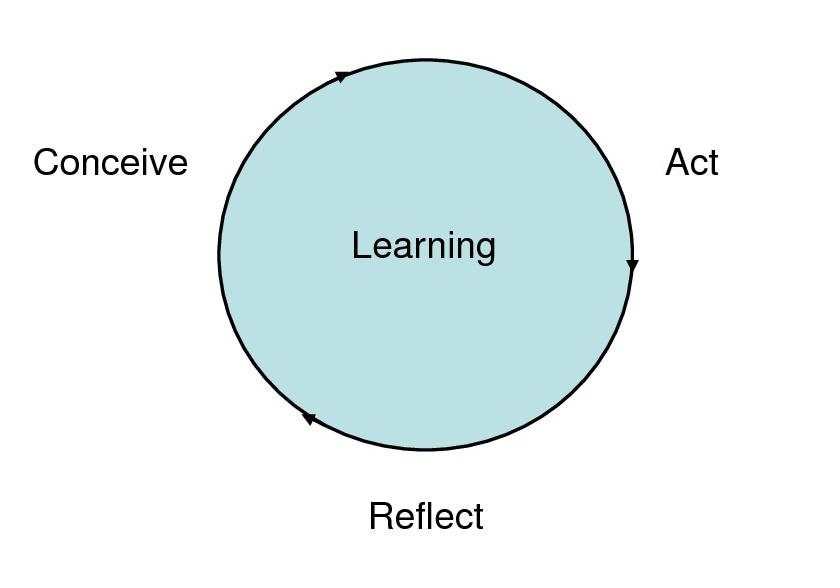
The implications of Organization learning are three-fold:
- One must understand how to create the ideal organizational learning environment
- One must be aware of how and why something has been learned.
- One must try to ensure that the learning that takes place is useful to the organization
Generally speaking, there are two approaches to organizational learning. The first view looks at the firm as a whole and examines learning from a cognitive perspective. The second view looks at learning as community-based, where the firm’s practitioners create knowledge in their own networks called communities of practice
Organizational learning (OL), according to Argrys & Schon is a product of organizational inquiry. This means that whenever the expected outcome differs from the actual outcome, an individual (or group) will engage in inquiry to understand and, if necessary, solve this inconsistency. In the process of organizational inquiry, the individual will interact with other members of the organization and learning will take place. Learning is, therefore, a direct product of this interaction. Argrys and Schon emphasize that this interaction often goes well beyond defined organizational rules and procedures. Their approach to organizational learning theory is based on the understanding of two (often conflicting) modes of operation:
- Espoused theory: This refers to the formalized part of the organization. Every firm will tend to have various instructions regarding the way employees should conduct themselves in order to carry out their jobs (e.g. problem-solving). These instructions are often specific and narrow in focus, confining the individual to a set path. An example of espoused theory might be “if the computer does not work, try rebooting it and then contact the IT department.”
- Theory-in-use: This is the actual way things are done. Individuals will rarely follow the espoused theory and will rely on interaction and brainstorming to solve a problem. Theory in use refers to the loose, flowing, and social way that employees solve problems and learn. An example of this might be the way someone actually solves a problem with their computer by troubleshooting solutions, researching on forums, asking co-workers for opinions, etc
In order to create an environment conducive to learning, firms are encouraged to accept the theory in use and make it easy for the individual to interact with his working environment in an undefined and unstructured way. Essentially they should provide the right environment for the organizational inquiry to take place, unconstrained by formal procedures. Levitt and March expand further on the dynamics of organizational learning theory. Their view presents the organization as routine-based, history-dependent, and target-oriented. While lessons from history are stored in the organizational memory, the event itself is often lost. They note that past lessons are captured by routines “in a way that makes the lessons, but not the history, accessible to organizations and organizational members.” The problem most organizations face is that it is usually better to have the event rather than the interpretation. However, this is often too costly (both financially and time-wise) to be feasible. OL is transmitted through socialization, education, imitation, and so on, and can change over time as a result of interpretations of history.
Argrys and Schon identify three levels of learning which may be present in the organization:
- Single loop learning: Consists of one feedback loop when the strategy is modified in response to an unexpected result (error correction). E.g. when sales are down, marketing managers inquire into the cause and tweak the strategy to try to bring sales back on track.
- Double-loop learning: Learning that results in a change in theory-in-use. The values, strategies, and assumptions that govern the action are changed to create a more efficient environment. In the above example, managers might rethink the entire marketing or sales process so that there will be no (or fewer) such fluctuations in the future.
- Deutero-learning: Learning about improving the learning system itself. This is composed of structural and behavioral components which determine how learning takes place. Essentially deutero-learning is, therefore “learning how to learn.”
Effective learning must include all three, continuously improving the organization at all levels. However, while any organization will employ single-loop learning, double loop and particularly deutero-learning are a far greater challenge.
Learning Within Communities of Practice
It describes a learning theory with a strong relationship to the social construction of knowledge. The community of practice consists of members who interact with each other for their pursuit of a common practice. It is, therefore, this collective social practice that links individuals together across official organizational boundaries and departments, and makes up the community. It is important to note that these are not teams. A community of practice can be defined as “a group of professionals informally bound to one another through exposure to a common class of problems, common pursuit of solutions, and thereby themselves embodying a store of knowledge”. Learning is seen as deriving from the social process of becoming a practitioner, as it gives the individual a social context of being an integrated part of a community. The social construction of identity shapes each person’s view and interpretation of the world. Learning and the creation of new knowledge can then take place within the context-dependent forum of the community and can be shared through social practice.
Botha et al summarize the key factors regarding communities of practice as follows:
- Learning is a social phenomenon
- Knowledge is integrated into the culture, values, and language of the community
- Learning and community membership are inseparable
- We learn by doing and therefore knowledge and practice are inseparable.
- Empowerment is key to learning: The best learning environments are created when there are real consequences to the individual and his community of practice.
Management must understand the advantages, disadvantages, and limitations of communities of practice. For example, because they are so loosely defined it may be very hard to identify them when a problem needs to be solved- to resolve this some companies today are mapping their communities of practice. Another issue could be the problem of transferring and combining knowledge across the firm. Due to the close ties to “doing” as well as the cultural elements, this may require innovative solutions- e.g. using temporary cross-functional project teams that can leverage knowledge from different areas, apply it, learn, and then redistribute the new knowledge back into the individual members’ communities.
Organizational Culture
Organizational culture determines values and beliefs which are an integral part of what one chooses to see and absorb. It includes a shared perception of reality, regarding how things are and how things should be. Furthermore, community and group culture determine the willingness and conditions for knowledge sharing with other members of the organization. Knowledge and knowledge sharing are thus inseparable from organizational culture.
Wellman essentially describes culture as “the way it is around here.” To illustrate the perseverance of organizational culture he presents an interesting allegory:
Put five apes in a cage. Then dangle a banana from the ceiling of that cage and place a ladder under it. Whenever an app attempts to climb the ladder to reach the banana, spray all of them with cold water. After a few times, the apes will associate climbing the ladder with being sprayed with cold water. One can now turn off the cold water. Then, replace one of the original apes with a new one. This new ape will undoubtedly try to get to the banana, but if he tries he will be attacked by the others. He will have no idea why this is so, but will soon learn that he must not climb the ladder. Next, replace yet another ape. When he approaches the ladder all the apes will attack him. One of these apes has no idea why he may not climb the ladder, but he participates in the punishment enthusiastically. Soon the new ape will also learn not to climb the ladder. In this way, one can continue until all the original apes are replaced. At this stage, none of them knows why they must not climb the ladder, but none will do so, and all will attack anyone that tries. All of this because “that’s the way it has always been around here.”
Strange as it may seem, this kind of cultural learning can be identified time and again in real-world organizations. Wellman points out that at times this can be beneficial and detrimental. Hardwiring a reaction can push the organization into action quickly against a perceived threat. The problem is that this “instinctive response may be inappropriate for the current environment but maybe triggered nonetheless”.
All in all, organizational culture can be split into levels:
- Artefacts: These represent the visible elements such as processes, structures, goals, climate, dress codes, furniture, etc. An outsider can see them but may not understand why things are the way things are.
- Espoused values: The values espoused by the leaders. They most often are grounded in shared assumptions (see below) of how the company should be run. If there is a significant mismatch between the leadership espoused values and this perception, the organization may be in trouble.
- Assumptions: These are the actual values of the culture. They refer to the (often tacit) views of the world itself (e.g. human nature). Again, these assumptions should need to correlate at least to a certain degree to the espoused leadership values for the organization to function smoothly.
The problems with managing culture can be summed up as follows:
- Culture reaffirms itself by rejecting misfits and promoting those that adhere to the norms of the organization.
- Culture often consists of learned responses that are hard-wired into the organization. The actual events that sparked this “lesson” may be long forgotten. This is very similar to the concept of organizational learning according to Levitt and March which indicates that organizations are far more likely to remember interpretations of events rather than the event itself.
- Culture contains falsehoods. Past lessons are applied often without understanding them and their reasons for being.
The Learning Organization
The term “learning organization”, not to be confused with organizational learning, describes an organization with an ideal learning environment, perfectly in tune with the organization’s goals. Such an organization is a place “where people continually expand their capacity to create the results they truly desire, where new and expansive patterns of thinking are nurtured, where collective aspiration is set free, and where people are continually learning to see the whole (reality) together.”
- The ideal organizational environment for learning, knowledge management (KM), innovation, etc, as described through the term “the learning organization”.
- The leadership qualities were necessary for promoting and encouraging this ideal environment.
According to Senge, the learning organization depends upon the mastery of five dimensions:
- Systems thinking: The notion of treating the organization as a complex system composed of smaller (often complex) systems. This requires an understanding of the whole, as well as the components, not unlike the way a doctor should understand the human body. Some of the key elements here are recognizing the complexity of the organization and having a long-term focus. Senge advocates the use of system maps that show how systems connect.
- Personal mastery: Senge describes this as a process where an individual strives to enhance his vision and focus his energy and be in a constant state of learning.
- Mental models: “Deeply ingrained assumptions, generalizations, or even pictures and images that influence how we understand the world and how we take action”. These must be recognized and challenged so as to allow for new ideas and changes.
- Building a shared vision: Shared vision is a powerful motivator. A leader’s vision does not necessarily become shared by those below him. The key here is to pass on a picture of the future. To influence using dialogue, commitment, and enthusiasm, rather than to try to dictate. Storytelling is one possible tool that can be used here.
- Team learning: The state where team members think together to achieve common goals. It builds on a shared vision, adding the element of collaboration.
The Role of Leadership
Senge emphasized the role of the leader in the creation of this learning organization. He defined three leadership roles that would reshape the old-fashioned approach to being the boss. These are:
Leader as Designer: Senge likens this to being the designer of a ship rather than its captain. He defined it in three ways:
- Creating a common vision with shared values and purpose.
- Determining the “policies, strategies, and structures that translate guiding ideas into business decisions.”
- Creating effective learning processes which will allow for continuous improvement of the policies, strategies, and structures.
Leader as Teacher: The leader here is seen as a coach that works with the mental models present in the organization. He must understand the (usually tacit) concepts of reality and restructure these views “to see beyond the superficial conditions and events [and] into the underlying causes of the problems.”
Leader as Steward: This is the vaguest of the three and refers largely to the attitude of the leader. He emphasizes the importance of a leader that feels he is part of something greater; whose desire is first and foremost not to lead, but to serve this greater purpose of building better organizations and reshaping the way businesses operate.
The first two roles outlined by Senge shed a lot of light into the requirements of effective organizational learning.
Botha et al Process Model

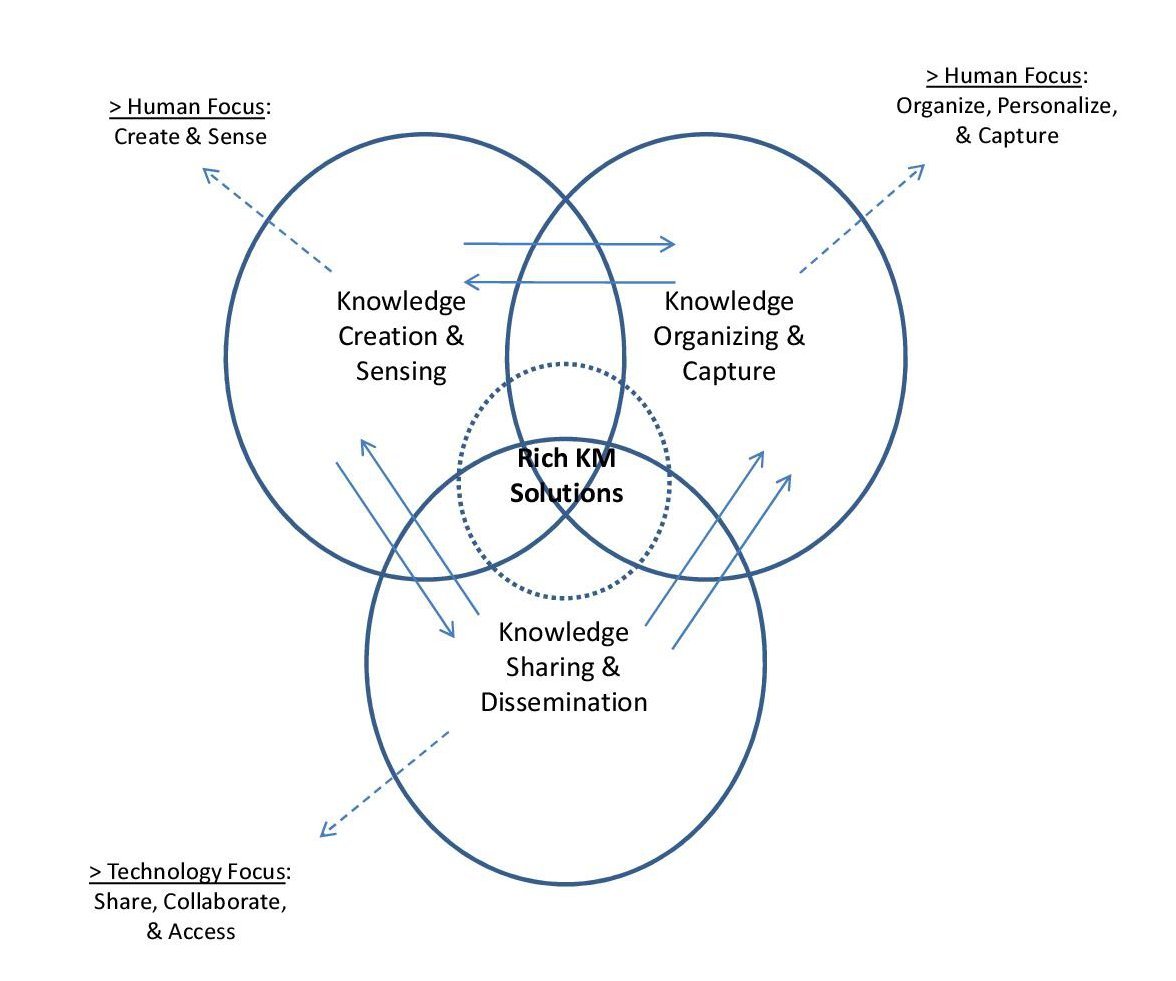
The three broad categories overlap and interact with one another. The focus is on managerial initiatives. Here too the strategic focus (the “when” and the “why” as opposed to the “what”) is omitted. It is noteworthy that this model does include the creation of new knowledge. The model further shows which of the three categories are more people-oriented and which are more technology-focused.
Knowledge Development Cycle:
The knowledge development cycle defines the knowledge management process in an organization, as a cyclic process from knowledge creation to knowledge review and revision.


The knowledge creation process involves the creation of new knowledge in the organization. This also includes activities like research and development, consulting, education, etc. The knowledge adoption process involves the adoption of created knowledge and adapting the knowledge. The knowledge distribution and knowledge review and revision process involve the conversion of converting the individual knowledge to organizational knowledge.
Knowledge Management Process:


KM involves processes that facilitate the application and development of organizational knowledge and aims to create value and to increase/sustain competitive advantage for the organization in 3 dimensions:
- Strategic dimension – highlights the strategic importance of knowledge and its management in a company’s strategy
- Managerial dimension – highlights organizational knowledge assessment and management
- Operational dimension – highlights the development and usage of knowledge and intellectual assets
KM supports and coordinates the generation, codification, transfer, and application of individual knowledge in value creation processes. There are generally 4 stages of KM processes:
1 Knowledge Creation/Generation
Companies create a great amount of data and information in their daily business activities. It would be essential for the company to have a system of managing the newly created information so it can be reused to solve new problems or leveraged to value-add to other business activities. For example, high technology companies may often receive a lot of feedback from customers on their products. This kind of information could be very useful for the R&D team to come up with new improved products. Companies may find that they cannot meet their knowledge requirement from their available knowledge assets. The gap will have to be filled either by internally developing new knowledge or acquiring the knowledge from external sources. Knowledge creation can only be achieved in a creative environment that encourages teamwork and the use of creative potential. If managed successfully, the process can expand or change the company’s knowledge base to meet the company’s current and future needs.
2. Knowledge Codification
Data and information need to be collected and analyzed in order to turn them into useful knowledge. This is the stage where tacit knowledge is converted into explicit knowledge and is very critical to the success of the other two stages – application and transfer. Without documenting and codifying tacit knowledge, its transfer for the purposes of learning and utilization, both internally and externally, will be difficult to achieve. Furthermore, the legal protection of these valuable knowledge assets can only be done if the knowledge has been codified. For example, patent applications require the complete disclosures of the inventions, and trade secrets require the demonstration of safe-keeping of documented information. The legal rights that come with IP protection offer the company a distinct advantage that can be used to derive revenues from IP licensing or exclusive rights to commercialize.
3. Knowledge Application
It is not unusual for companies not to know how to generate value from the use of the knowledge assets they have. It is worse when a company does not even know the kind of knowledge it has. Knowledge Management offers a management system for the company to ensure that their knowledge assets when created are properly documented and that the knowledge in different domain owners will be shared within the organization. When knowledge assets are documented and shared, knowledge utilization will be facilitated. This is the stage in Knowledge Management where value creation is delivered. By harnessing knowledge from different knowledge domains and competencies across the organization, direct impacts to the missions and goals of the company can be achieved.
4. Knowledge Transfer
One of the advantages of knowledge is that knowledge is dynamic. Knowledge can be adapted and evolved through the processes of learning and sharing. The impact made by individual knowledge is not as great as collective knowledge so sharing within the organization should be encouraged. When a company has limited capability to effectively use certain knowledge, it would be worthwhile to consider external transfer to third parties who may have the competencies to utilize the knowledge for value creation. For example, a company may have invented a new technology but does not have the capability to produce products based on such invention. The technology can be licensed to a third party that has the production facilities and the marketing and sales capability to sell the new product. To ensure the success of this technology transfer, it is essential that tacit knowledge and procedural knowledge are converted to explicit knowledge for easy learning, adaptation, and utilization.
Subscribe to get access
Read more of this content when you subscribe today.