

Using Benchmarking to achieve Process Improvement
The definition of Benchmark is “a mark on a permanent object indicating elevation and serving as a reference in topographical surveys and tidal observations”, “a point of reference from which measurements may be made”, ” something that serves as a standard by which others may be measured”.
Omdahl defines benchmarking as a continuous improvement process in which a company:
- Measures the most relevant specific attributes of its own products, services, and practices, often including Operations, Performance, Procedures, Project, Processes, Strategies
- Compares its own performance against:
- Best-in-class company performance.
- Companies recognized as industry leaders.
- The company’s toughest competitors.
- Any known process that is significantly superior to the company’s.
- Determines how those companies achieved their significantly superior performance level.
- Uses that information to improve its own performance.
- Ultimately reaches the level of performance achieved by the benchmarked process (or a level above that process).
- Continually repeats the process in an iterative fashion.
Juran presents the following examples of benchmarks in an advancing order of attainment:
- The customer specification
- The actual customer desire
- The current competition
- The best in related industries
- The best in the world
Benchmarking is the process of comparing the current project, methods, or processes with the best practices and using this information to drive improvement of overall company performance. The standard for comparison may be competitors within the industry but is often found in unrelated business segments. Benchmarking has gained tremendous influence and usage in the 1990s. Correspondingly, front-line employees and operating managers have applied basic benchmarking skills in scores of different business situations. Benchmarking is done to identify opportunities, set realistic but aggressive goals, and challenge internal paradigms on what is possible. Benchmark helps us to understand methods for improved processes. It uncovers strengths within your organization. we can learn from the leaders’ experiences and prioritize better to allocate resources. It helps in Performance Improvement. These applications can be grouped into distinctive types. Examples are explained below:
Process Benchmarking
Process benchmarking focuses on discrete work processes and operating systems, such as the customer complaint process, the billing process, or the strategic planning process. This form of benchmarking seeks to identify the most effective operating practices from many companies that perform similar work functions.
Performance Benchmarking
Performance benchmarking enables managers to assess their competitive positions through product and service comparisons. This form of benchmarking usually focuses on elements of price, technical quality, ancillary product or service features, speed, reliability, and other performance characteristics.
Project Benchmarking
Benchmarking of project management is easier than many business processes, because of the opportunities for selection outside of the group of direct competitors. Areas such as new product introduction, construction, or new services are activities common to many types of organizations. Although the project objectives are different, the projects will share the same constraint factors of time, costs, resources, and performance. Project management benchmarking, is useful in selecting new techniques for planning, scheduling, and controlling the project.
Strategic Benchmarking
In general terms, strategic benchmarking examines how companies compete. Strategic benchmarking is seldom industry-focused. It moves across industries seeking to identify the winning strategies that have enabled high-performing companies to be successful in their marketplaces.
Harry suggests that companies should always know their strongest competitors on a process by process basis. Benchmarking provides measurements of a company’s performance compared to the competition and is an essential part of six sigma projects during the measure and analysis stages. It is especially helpful for evaluating higher-level processes at the business and operational levels where both the measures and their allowable ranges are often in question.
It should be noted, in this regard, that benchmarking results should be treated like any other measure. A single value (benchmark result) should not receive too much value, especially when the normal range of values for that measure is not well known. In those situations where there are no known or related processes available, a company may have to resort to either reengineering or related techniques to improve the operation, project, product, or activity of concern. As identified in SWOT analysis, internal weaknesses and external threats are good sources for competitive benchmarking.
| Without Benchmarking | With Benchmarking | |
|---|---|---|
| Defining Customer Requirements |
|
|
| Establishing Effective Goals |
|
|
| Developing True Measures of Productivity |
|
|
| Becoming Competitive |
|
|
| Industry Practices |
|
|
Some companies attempt to achieve a higher performance level than their benchmark partner. Shown below is a comparison between a typical and a breakthrough benchmark approach.

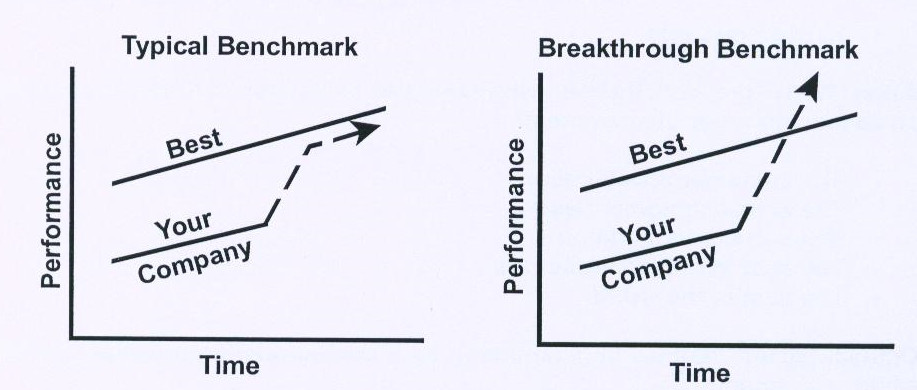
Benchmarking Comparison
The competitive benchmarking partner presents some interesting options. For example, Xerox Corporation has used IBM and Kodak (direct competitors in many product lines) as benchmarks for many Xerox operations. However, Xerox chose L.L. Bean Company, a catalogue sales distributor of clothing and consumer products, as a benchmark for warehousing and distribution activities. They did this because they felt L.L. Bean to be world class.
In some cases, a benchmarking against the best-in-class is not possible because:
- The best in world is not known (should be rare)
- There is no related process available (rare)
- The best-in-class is not willing to partner
- The best-in-class is inaccessible due to geography or expense
- It should be noted that organizations often choose benchmarking partners who are not best-in-class because they have identified the wrong partner or simply picked someone who is handy.
Types of Benchmarking
- Internal: Comparisons between yourself and similar operations within your own organization.
- Competitive: Comparisons among competitors for a specific product.
- Functional: Comparisons to similar functions within the same industry.
- Generic: Comparisons of processes independent of industry or overall functions.
Cost/Benefits Analysis:

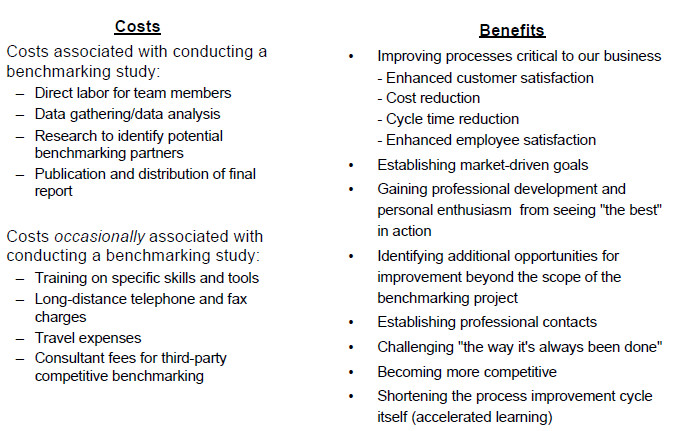
Benchmarking Sequences
Often, benchmarking activities follow the sequence below:
- Determine current practices
- Select the problem area.
- Identify key performance factors.
- Understand your own processes and the processes of others
- Select performance criteria based on needs and priorities
- Identify best practices
- Measure the performance within the organization
- Determine the leader(s) in the criteria areas
- Find an internal or external organization to benchmark with
- Analyze best practices
- Visit the organization as a benchmark partner
- Collect information and data of the benchmark leader
- Evaluate and compare current practices with the benchmark
- Note potential improvement areas
- Model Best Practices ‘
- Drive improvement changes to advance performance levels
- Extend performance breakthroughs within the organization
- Incorporate the new information in business decision making
- Share results with the benchmark partner
- Seek other benchmark leaders for further improvement
- Repeat the cycle
The Benchmarking Process

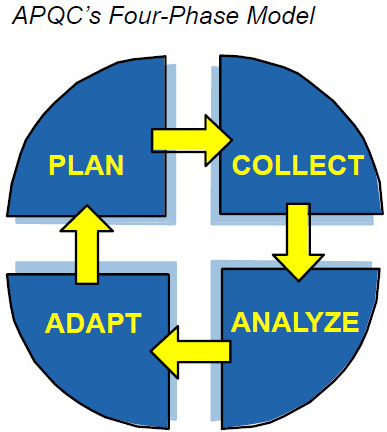
Planning Phase
- Form (and train, if needed) benchmarking team
- Analyze and document the current process
- Identify the area of focus
- Identify the critical success factors (CSF)s for the area
- Develop measures for the CSFs
- Establish scope of benchmarking study
- Develop purpose statement
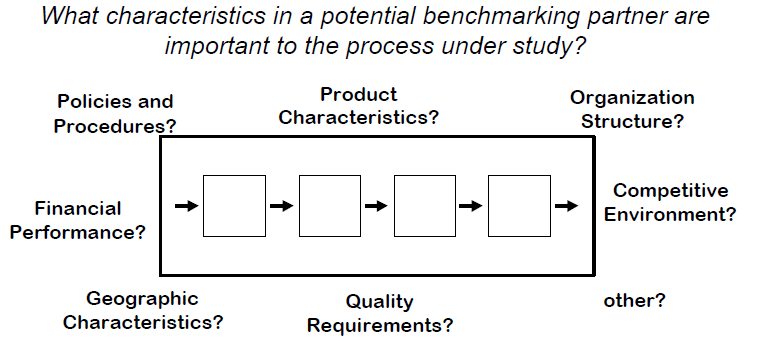
- Develop criteria for benchmarking partners
- Identify target benchmarking partners
- Define a data collection plan and determine how the data will be used/managed/distributed
- Identify how implementation of improvements will be accomplished
Collection Phase
- Secondary research based on select/sort criteria
- Evaluate results and identify potential partners
- Develop data collection instruments
- Pilot data collection instruments internally
- Identify and contact best practice partners and enlist participation
- Screen partners and evaluate for best “fit” with criteria
- Develop detailed questionnaire
- Conduct detailed investigation
- Detailed questionnaire
- Follow-up telephone interviews
- Site visits
Analysis Phase
- Compare your current performance data to your partners’ data
- Sort and compile data
- Make your performance data comparable (normalize)
- Identify gaps
- Identify operational best practices and enablers
- What are participants doing that you are not doing
- How do they do it (enablers)
- Formulate strategy to close the gaps
- Assess adaptability of practices and enablers
- Identify opportunities for improvement.
- Develop implementation plan
Adapting Improvements
- Implement the plan
- Monitor and report progress
- Document the study
- Communicate the results (internally and to benchmarking partners)
- Assist in the internal transfer of best practices
- Plan for continuous improvement
- Identify new benchmarking opportunities
- Set new goals
Tools of Benchmarking
Process Mapping
Think of yourself as the product. Then…
– Walk the process and see what happens to you
– Identify each activity
– Determine if you are being operated on, transported, inspected, waiting, or stored
– Determine how far you were moved
– Determine how long each activity took
– Determine what value-added work was done on you
– Summarize the information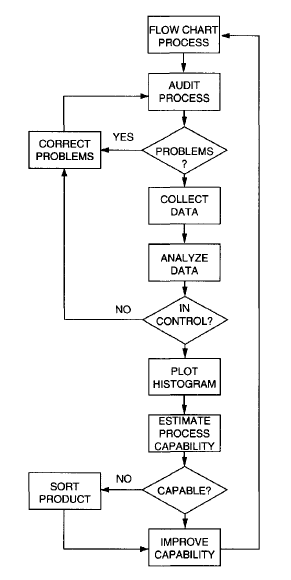
Process performance measurements
Performance measurements are tied to customer expectations and is aligned with strategic objectives. It should be clearly reflective of the process (not overly influenced by other factors). Data should be easily obtained and understood and can be monitored over time. Examples are Cycle time, Rejects per month, Costs.
Project management
Project management techniques are useful in Planning the benchmarking study and Developing the implementation plan.
Questionnaire design
- Keep the questionnaire simple (no more than 2 pages).
- Determine the intent of the questionnaire
- screen potential benchmarking partners, or
- obtain specific process-related information from a selected partner(s)
- Briefly explain the study’s purpose and how their responses will be used.
- Be specific about the process under study. (hint: include a simple process map)
- Use neutral language. Don’t ask questions that presuppose the answer.
- Test the questionnaire internally on people who are unfamiliar with your project.
- Are the questions clear? Do the responses really address your issues?
- Answer the questionnaire about your own process.
- Ask yourself, “What kind of response do I expect from this question, and what will I do with the information when I get it?” Focus on the critical issues.
- Don’t use acronyms or organization-specific terminology. (No TLAs)
- Ask the respondents to forward the questionnaire if others are better able to answer the questions.
- Provide a contact from the benchmarking team, and an address (or fax number) where the questionnaires should be returned or issues clarified.
- Indicate whether the respondent should expect any further contact from your team.
- Thank the participants for their cooperation.
- Interviewing skills
- Observation skills
- Etiquette and legal issues
Interviewing Skills
- Be prepared. Know your own process and its performance measurements. Be familiar with the questions you will be asking, and have other questions thought out that would help you elicit additional information.
- Be sensitive to the protocol and culture of your benchmarking partner. Follow their lead.
- Use a standard set of questions with each benchmarking partner, but be flexible in the interview to permit them to share additional information. You might ask, “Is there anything that we’ve failed to ask you that might be useful to us?”
- Practice active listening skills, and listen more than you speak. Never argue-among yourselves or with your partners.
- Gather facts, but be open to hearing opinions.
- Be candid about the deficiencies of your own process, but don’t assign blame.
- Be considerate of your benchmarking partners’ schedule constraints. Never take more time than you have scheduled unless you are encouraged to do so by your partners.
- Thank your partners for their cooperation, and indicate if/when they should expect any further contact from your team.
Observation Skills
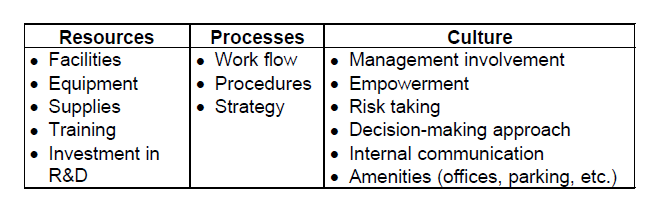
Site visits provide opportunities to observe the enablers in place at your benchmarking partners


7. Benchmarking Etiquette
- Don’t ask for data that you aren’t willing to provide in return.
- Remember that you and your team represent your whole company in the eyes of your benchmarking partners.
- Send questions in advance of telephone conversations or site visits.
- Inquire up-front about confidentiality issues or topics that are “off-limits.”
- Never press for information that is not willingly given.
- Don’t reveal information that other benchmarking partners have given you unless you are certain it was meant to be shared with other companies.
- You may offer to share findings of the study, keeping in mind any issues of confidentiality between partner companies.
- When in doubt, don’t ask!
Keys to Successful Benchmarking
- Focus on the processes that are critical to your business
- Desire to use benchmarking in conjunction with strategic planning
- Willingness to admit that you’re not the best
- Openness to new ideas from potentially unexpected sources
- Commitment to provide resources and to overcome resistance to change
- Recognition given to successful benchmarking teams
- Understanding of the benchmarking process
- Communication to the organization about the objectives of the benchmarking project
When You Shouldn’t Benchmark
- You aren’t targeting a process or it isn’t critical to the business
- You don’t know what your customers require from your process
- Key stakeholders aren’t involved in the benchmarking project
- Inadequate resources have been committed
- You have an unreasonable fear of sharing information with benchmarking partners
- There are no up-front plans for implementing your findings
- You haven’t done your “homework” before contacting benchmarking partners
- You’re benchmarking an organization rather than a process
- There is a strong resistance to change (NIH syndrome)
- When you are expecting results instantaneously
Illegal Benchmarking Practices
- Submitting phony requests for information in order to obtain pricing information
- Performing reverse engineering when the product is obtained illegally
- Covert photography or tape recording
- Violations of Antitrust Law/Unfair Trade Practices: Requesting information from direct competitors on Marketing strategies, Sales incentives, Cost or pricing data (other than commercially available price lists), Contract terms and conditions,
- Unethical practices
- Misrepresenting yourself, your company, or your intentions in obtaining information
- Querying job candidates about practices of their present employers
- Using information that was given to you for a specific purpose for another reason without first obtaining permission from the benchmarking partner who provided it
Where Do You Start the Search for the Best?
- Focus on the process, not the company
- All of the processes at world-class companies aren’t world-class processes (beware of the “halo” effect)
- Even mediocre companies can have a world-class process or two
- Weigh the ease of getting access against possible performance compromises
- Understand the spectrum from parity (just “different”), to some improvement over the current process, to best practice, to best-in-class or world-class.
- Decide “best-in-class” or best-in- Pune or somewhere in-between

Tapping into “Hidden” Resources
- Resources that are internally accessible
- Library databases and literature searches
- Employees who have worked at other companies, in other industries
- Sales and marketing personnel
- Field service personnel
- Media attention — articles, shows
- Other divisions of your organization
- Resources that require external contact
- Professional associations
- Industry publications
- Customers
- Suppliers
- Industry/ Marketing Association
- Seminars and conferences
- Universities and alumni associations
- Benchmarking clearing houses
- Consultants
Establishing a Relationship with Benchmarking Partners
- Initial contact must establish expectations
- Mutual benefit
- Effective/disciplined use of information
- Cultural fit
- Thorough preparation
- Willingness to share
- Respect for any issues of confidentiality
- Process-specific information might include
- Process map
- Physical layout of the process (including floor space)
- Quality data
- Cycle time data
- Pictures of equipment and equipment/materials lists
- Associated procedures, forms, standards, and specifications
- Customer and supplier requirements
- Skills required and the syllabus from associated training
- Descriptions of any associated regulations, environmental factors, and healthy and safety data requirements
- You may also want to offer the following information about your organization and may want to ask for similar information from your benchmarking partners
- Brochures describing the organization
- Organization charts
- Newsletters
- Preparing for a Site Visit
- Get agreement on the agenda
- Send a confirmation letter (restate your intentions, ensure that the right people are present, and permit your host to review your questions)
- Clarify any issues of confidentiality
- Ensure that each member of your team understands his/her areas of responsibility
- During Site Visits
- Pay attention during introductions (names, responsibilities, experience)
- Ask to tour the facilities, if possible, in addition to the areas involved in the subject process. Clarify the protocol for talking with employees during the tour
- Take thorough notes
- Use breaks and lunch to build rapport
- Be observant; look for the enablers
- Be open to “the unexpected”
- Learning From the Best and Translating Information into Action
- Analyze the data and insights gathered from benchmarking partners
- Compare process performance measurements
- Review goals
- Prepare a gap analysis
- Understand the factors that contribute to your partners’ superior performance
- Which can be adopted?
- Which can be adapted?
- Map the “to-be” process
- Use project management skills to identify tasks, resources, and schedule to implement process changes
- Identify who must be “sold” on process changes
- Implement and monitor process performance
- Analyze the data and insights gathered from benchmarking partners
- Last Steps
- Send a letter of appreciation
- Ensure that any concerns your partner raised have been addressed
- When completed, send a courtesy copy of your final report
- Capture lessons learned from the benchmarking process itself
- Review new process performance to ensure that improvements have been sustained
- Identify other candidate processes for benchmarking
- Potential for additional exchange with benchmarking partners
- Build on success

Subscribe to get access
Read more of this content when you subscribe today.