

Voice of the Customer (VOC)
An understanding of the needs of the customer is critical to the survival of most companies. The pace of change in today’s economy mandates that a company cannot rely on its past knowledge of the customer. A detailed plan to gather and collect customer needs and customer perceptions can be described as listening to the voice of the customer (VOC). This enables the organization to:
- Make decisions on products and services
- Identify product features and specifications
- Focus on improvement plans
- Develop baseline metrics on customer satisfaction
- Identify customer satisfaction drivers
An interesting concept to consider in this technique is to determine the reactive approaches being used and then replace them with proactive approaches. The following steps can be taken for collecting VOC data:
- Identify customers and their needs
- Collect and analyze reactive data (complaints, service calls) and then consider proactive approaches (interviews, surveys)
- Convert collected data into customer needs
- Sort out the most important attributes (the critical characteristics)
- Obtain specifications from the critical to quality characteristics
Not only can VOC input be useful in product and process design, but it can also be critical in six sigma team project selection and measurement.
Project Stakeholders
Any quality improvement project with high impact will bring about major changes to a system or to the entire company. The change can affect various people inside and outside of the system. Major resistance to the change can develop. As part of the defined process, attempts to remove or reduce the resistance must be made. The stakeholders involved should be identified and then a plan to convert them or to enroll them in the change process must be developed. This should provide for the needed buy-in, alternate solutions, and removal of pitfalls. Stakeholders can be identified as:
- Managers of the process
- Customers
- People in the process
- Suppliers
- Upstream people in the process
- Finance
- Downstream people in the process
A communication plan for the stakeholders should be developed. The communication plan should involve the stakeholders and identify, on a scale, the level of commitment or resistance that the stakeholder is perceived to have. A communication plan should then be developed to reduce or remove the resistance to the change.
Identify the Customer
Total Quality is built around the customer. Everything starts and ends with customers. They define quality and ‘set expectations. They rightfully expect performance, reliability, competitive prices, on-time delivery, service, and clear and accurate transaction processing. At times, the customer of the project may not be as evident as initially thought. The receiver of the next operation, an internal department, could be thought of as a customer. The external customer of a process could be the purchaser. But yet, if the purchaser is a distributor, then they may not really be the true customer. The primary customer of the process will or should have the highest impact on the process. The primary customer is of utmost importance to the process. The sorting out of the primary customer may take some discussion on the team’s part. The question of “Who is the customer?” may bring out discoveries of “Which customers make us money?”. That is, are there certain customers that make up the bulk of company revenues? Is there a small proportion of customers that simulate the Pareto law? The case is that 80% of the revenues come from 20% of the customers, or that 80% of the net profit comes from 20% of the customers. External customers are the most important part of any business. If one can identify them and understand their requirements, we can design products (goods and services) that they will want to buy. Every business has many potential customers, and each customer has their own decision criteria. They attempt to weigh the overall value of goods and services by considering cost, quality, features, and availability factors (CQFA). Businesses compete for customers on this CQFA value grid and must excel in at least one category in order to succeed. Any flaw with customer data would be like “getting information from the wrong customers.” Companies are eager to sell products. Products are initially designed for a particular market segment, yet anyone can usually obtain the product. Those products sold to that “undersigned” market segment will not receive the best product for their needs. Therefore, customer satisfaction surveys may result in information that reflects the thoughts of a market segment for which the product was not intended. The largest portion of unhappy customers may come from the unintended end user. The company will then react to the bad data. Fingers will be pointed in the wrong direction. Even worse, the organization may fix the wrong problem.
Customers can constitute:
- Current, happy customers
- Current, unhappy customers
- Lost customers
- Competitor’s customers
- Prospective customers
The following methods can be used to collect information and data from customers or would-be customers:
- Surveys
- Focus groups
- Interviews
- Complaint systems
- Market research
- Shopper programs
- Targeted and multi-level surveys
- Targeted and multi-level interviews
- Customer scorecards
- Data warehousing
- Data mining
- Customer audits
- Supplier audits
- Quality function deployment
The information gathered should allow the organization to identify customer requirements and spot upcoming trends. The trends will be new ways for the company to gain or retain customers. Customers seem to be more satisfied if they receive feedback than if they do not receive feedback. Clearly, the voice of the customer is critical to business success. The relationship that management can develop with either basic customer type will affect the company’s ability to be effective in delivering customer satisfaction.
Internal Customer
An internal customer can be defined as anyone in the company who is affected by the product or service as it is being generated. The internal customer is sometimes forgotten in the effort to produce an item or service for the external customer. The immediate goal should be to produce the product or service in a simple and convenient manner for internal consumption. The effort to remember to do things a specific way, to be trained properly, to be given the proper equipment, or to be given specific instructions can often be neglected. Internal customers are often employees of the company. Kaoru Ishikawa coined “The next operation as customer” in order to remove the sectionalism of departments toward each other. The essential idea is to enable employees of all departments to come together to solve problems. Staff members such as design, manufacturing, purchasing, project, and plant engineering must consider themselves as service providers. Otherwise, the staff members are in constant struggle with the line management and employees, and nothing gets done. Within a company, the staff should consider what kind of work they can perform for the line departments. Research has shown that management practices relate to employee satisfaction, which also impacts customer satisfaction. When employees are satisfied with their treatment, given the right tools to do the job, and supported by management; customers are more likely to have higher perceptions of quality and will continue to do business with the company. Internal employee communications for customer satisfaction can be improved through the following options:
- Company newsletters: Basic information, corporate news
- Story boards: A wallboard display; memos, letters, projects, etc.
- Team meetings: Share business news or announce new events
- Posting customer letters of appreciation or dissatisfaction
- Staff meetings: Share the information
- Display of goals, progress charts, etc.
- Quality awards from customers
To stay competitive in this environment, a constant schedule of training for the entire workforce is required. Typical employee training must focus on helping them do their job better.
External Customers
External customers are not part of the organization but are impacted by it. End users, Intermediate customers, and impacted parties are described in more detail below. Generally, external customers play a critical role by providing a major portion of company revenues.
- End Users
The category of external customers includes those that purchase a product or service for their own use. In this case, they would be the “end-user” of the product. - Intermediate Customers
Intermediate customers purchase the product or service and then resell, repackage, modify, or assemble the product for sale to an end-user. These “channels” can provide volume sales opportunities for a business but will have significantly different requirements than end-users.
Examples of intermediate customers include:- Retailers
- Distributors
- Manufacturer’s representatives
- Wholesalers
- Transport companies
- Impacted Parties
The third external category is those who did not purchase or use the product but are impacted by it. Certainly, the families of the authors would be in this category.
Meeting external customers’ needs can become a complex process.
External Customer Identification
External customers may be sorted in many ways in an attempt to better understand their requirements and identify possible market niches. Business customers can include for-profit and not-for-profit enterprises. Examples of not-for-profits might include schools, hospitals, public agencies, etc. The various customer groups could also be reviewed for:
- High-profit margin
- Competition in market
- Risk of market
- Growth in market
The consumer customer market differs from the business market as follows:
- The consumer market has a large number of customers
- The majority of consumer purchases are small in actual dollar amounts
- The transaction is usually a simple purchase
- Most consumers are not very knowledgeable about the product
- The supplier does not share proprietary information with the consumer
- In contrast, the business customer acts in the following manner:
- There are a very small number of business customers; maybe only one
- The amount purchased per transaction is quite large
- The purchase is handled through specialized personnel
- The customer may know more about the requirements than the producer
- The supplier may allow the customer access to all sorts of information
- It is also important to look at the market for the next two to five years and estimate how it will change and grow. This requires a look at all potential customers and their requirements.
Customer Service
The customer-driven company is beginning to emerge in America. A project team could certainly focus on an improvement in customer service. The public demands and expects better quality products and services. One sample program follows:
- Listen to the customer: customer needs
- Define a service strategy: the customer focus
- Set standards of performance: needed for measures and results
- Select and train employees: the right employees and the proper training
- Recognize and reward accomplishment: not enough of this is done
There is the need to listen to the customer, provide a vision, provide training, improve the process, find or develop response metrics, and measure the results. About 70% of customers who leave a company do so not because of the product quality, but because of service quality. Whiteley suggests that the following information is essential:
- To determine who your customers are
- To know those customers’ needs and expectations
- Work toward satisfying those needs and expectations
Note, there is also a need to obtain information from non-customers.
Customer Retention
Most organizations spend the bulk of their resources on obtaining new customers and smaller amounts on retaining customers. High customer satisfaction numbers do not necessarily mean the company has good customer retention and good customer loyalty. It has been found that current customers are worth as much as five times more than new customers. The cost of retaining a current customer is only one-fourth the cost of acquiring a new customer. Another study showed that companies will boost profits by about 100% by just retaining 5% more of their customers. The life cycle of a customer is defined by 5 stages:
- Acquisition: Converting a prospect to a customer, high costs
- Retention: Keeping the customer, 1/4 of the cost to acquire them
- Attrition: Customer enthusiasm fades, as dissatisfaction creeps in
- Defection: Losing the customer
- Reacquisition: Regaining the customer, but at an even higher cost
The effort to retain customers requires some effort on the company’s part. Over 60% of dissatisfied customers are so tired of poor service that they think it is futile to complain. Customers buy expectations, not just products and services. A happy customer is sometimes known as an “apostle.” The apostle is thrilled and enthused with the product and is willing to tell the world about it and your company. They will assist you with product troubleshooting when problems occur and are your best source of new product ideas. Clearly, the objective is to create and nurture more apostles. Unfortunately, an unhappy customer can be even more devastating. They can become “terrorists,” and will broadly spread a negative message. Some techniques for getting to know customers better:
- Don’t use your own instincts as research data (you’re not the customer)
- See the world from the customer’s side
- The higher you are in the organization, the more out of touch you are
- Get customers to talk: 90% to 96% of unhappy customers won’t complain
- Do research to retain customers
- Determine how satisfied customers are
- Conduct research on customer expectations
- Develop a customer profile
- Share the results of customer research studies a
- Don’t go overboard on the details and measurement
- Coordinate and use research efforts
- Understand that sometimes research does not help the situation
Customer Loyalty
The value of a loyal customer is not measured on the basis of one gigantic purchase, but rather on his/her lifetime worth. Loyal customers account for a high proportion of sales and profit growth. Customer retention generates repeat sales, and it is cheaper to retain customers. For example, in life insurance, a new policyholder becomes profitable in 3 years. In the credit card business, the break-even point for a new customer is 6 years due to high marketing and bad debt costs. Customer loyalty is something that must be demonstrated through an act of execution, trust, or delightful service. They become partners.
Customer Metrics Selection
The metrics that will affect projects involving suppliers, internal processes, and customers would be quality, cycle time, cost, value, and labor.
The primary metrics for consideration in a project could come from several sources:
- Suppliers
- Internal processes
- Customers
Garvin and Besterfield suggest nine dimensions of quality measurement:
- Performance: Primary features of the product
- Features: Secondary features added to the product
- Conformance: Obtaining a product that meets fit, form, and function
- Reliability: The dynamic quality of a product over time
- Durability: Useful life
- Service: Ease of repair
- Response: Human interface
- Aesthetics: Product appearance
- Reputation: Based on past performance
Hill presents similar measurements that are important in the marketplace. Hill framed his characteristics to answer the question, “How do products win orders in the marketplace?” His suggested measurements are:
- Price
- Product range
- Conformance quality
- Design
- Delivery speed
- Brand name
- Reliability of delivery
- Technical support
- Demand increases
- After sales support
- Color range
The secondary or consequential metrics would be derived from the primary metrics. For example, if cycle time was determined to be a key metric, the next step would be to establish the numerical measurement. Examples of measurements include:
- Defects per unit (DPU)
- Defects per million opportunities (DPMO)
- Average age of receivables
- Lines of error free software code
- Reduction in scrap
Collecting Customer Data
Collecting data to gain “the voice of the customer” is a multi-level task. When collecting data from customers, it helps to consider the levels where customers impact the business.
- Business Level
Customers at this level are primarily shareholders and top management employees. The data of interest is primarily financial data such as stock price, market share, revenues, earnings, return-on-investment (ROI), return-on-net assets (RONA), etc. Typical measurement intervals may be quarterly or annually. - Operations Level
Customers at this level are primarily those who purchase the product (external) and those who manage production operations (internal). Data of interest measures overall process performance with the focus on customer satisfaction (external measures of operational effectiveness), and internal operations efficiency (internal measures such as rolled throughput yield, sigma levels, WIP inventory, etc.). Typical analysis tools come from six sigma methods and lean manufacturing, industrial engineering, and various forms of operations analysis. Typical measurement intervals may be daily or weekly. - Process Level
Customers at this level are primarily internal, including employees and the “next process” in the operation. External customers include suppliers for detailed materialspecification questions. Data of interest primarily involves key process variables. Typical analysis tools are statistical methods for process control, capability, and improvement. The typical measurement may vary from hours to fractions of a second, depending on production rates. Since employees are customers, they should be surveyed on a regular basis. Jack Welch has stated that employee satisfaction is a key toward greater productivity and quality. He feels the survey factors should include:- Job satisfaction
- Advancement fairness
- Training
- Treatment: respect & dignity
- Pay
- Company’s interest in the well-being
Voice of the Internal Customer
Surveys can establish a communication process serving as a tool for overall improvement. Information should be gathered on improvement efforts and some of the following factors:
- State of the company: What is the employee’s perception of the company?
- State of quality efforts: Are the quality efforts worthwhile?
- State of the processes: Are there improvements?
- Reaction to policies: What dumb things have been implemented?
- Rating of job satisfaction: Do I like my job, my boss, etc.?
- Rating of company satisfaction: is the company a good place to work?
Voice of the External Customer
The voice of the customer is an expression for listening to the external customer. It is necessary to have constant contact with the customer. To some companies, complaints are the only way that they listen to their customers. It has been stated that complaints are gold because complaints let the company know how to improve, and how to beat the competition. Among the ways that a company can listen to the external customer are:
- Immediate customer surveys
- Customer follow-up surveys (6 months, 1 year, 2 years)
- Community surveys: a look at what the community is doing
- Personal customer contact: CEO spends one day per month with a customer
- Customer contact reports given to the contact employee
- Focus groups: small and large groups
- Customer interviews or councils
- Electronic mail
- Test marketing: a small area is tested for use
- Quality guarantees: if not satisfied, we will redo the training
- Inspectors: use of mystery shoppers, auditors
- Ombudsmen: advocates for the customer
- Use of toll-free phone numbers or suggestion boxes
Determining Critical Customer Requirements
Customers ultimately determine the value of any product (goods and services) with their decision to buy or not buy. These decisions are made based on a complex system of critical customer requirements. In order to manage (control and improve) any business process, one must be able to determine the critical customer requirements that influence these decisions. Customer value consists of cost, quality, features, and availability factors (CQFA). To prosper, a business process must do well in at least one of these four areas while at least meeting acceptable levels in the others. If a business can be “best in class” in one of these four quadrants, or above average in more than one quadrant, they can thrive. However, the level of the bar in all of the quadrants is constantly changing because of the environment and competition. For this reason, the determination of critical customer requirements must be a continuing activity rather than a one-time study. In addition to looking at customer’s CQFA preferences, it also helps to understand the entire system of customer expectations, needs, and priorities. To understand the critical relationships and interactions of all these factors, tools, such as the cause-and-effect matrix and quality function deployment, should be employed.
Customer Expectations
Deep knowledge and understanding of the customer are required in order to properly serve them. There is a need to go beyond the sale, to uncover the subjective factors of why the product was purchased. By emphasizing the need to listen to the customer, one will gain a better understanding of the customer’s expectations, priorities, and needs. The customer’s expectations can be described through an analogy similar to Maslow’s hierarchy of human needs. :
- Basic: The bare essential attributes of the product or service should be present. A new personal computer should be assembled, formatted, and loaded with some basic software. A rental car will be serviced and operating properly.
- Expected: Some attributes will be provided as a part of the product. A knowledgeable technician may provide general operating features of a personal computer. The rental car should be conveniently located, features explained, and policies clarified.
- Product simplification features: New products can be complicated to use. Products or services should help ease the conversion to their use.
- Communications: The need to be informed and to be given access to rightful information. An open-door policy is a must for many situations.
- Service for product failures: When a product fails, what recourse (warranties, returns, exchanges, etc.) does the customer have? A newly purchased tennis racket cracks. What is the replacement policy?
- Customer service: Customers are expecting companies to have properly trained personnel on hand to handle complaints. The agent of the company should be empowered to satisfy the customer at that point. Customers’ needs are changing at a more rapid rate than ever before. They require new products or services to take the place of existing or inadequate ones.
Customer Priorities
The customer will have priorities as to which of their many expectations and needs will be met. Thus, a supplier has a problem in determining how to know what their customers want and what the company’s priorities should become. Services or products that are of a high priority today, maybe unimportant 5 years later. This could be related to the sale of newspapers. They are very high in importance at the moment of publication, but not as high in value in 5 years (unless that particular issue featured something outstanding). Companies can make use of customer interviews, surveys, focus groups, phone surveys, mail surveys, audits, sales reports, or other data gathering tools to identify customer needs and expectations. Those same tools can be used by the customer to assign priorities to the quality attributes of the company’s product or service. The tools do not have to be complicated but should ask the right questions:
– What attributes are of value?
– How desirable is each attribute (using some form of rating)?
– How do we compare with competitor’s products?
– What other features or services would be of value?
The use of priorities for customer needs and expectations can enable the company to respond in a more timely manner.
ELEMENTS OF CUSTOMER-DRIVEN ORGANIZATIONS
The proper place of the customer in the organization’s hierarchy is illustrated in Figure below. This perspective is precisely the opposite of the traditional view of the organization. The difficulties involved in making such a radical change should not be underestimated.

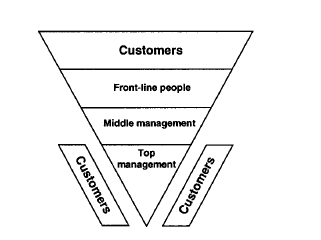
A customer- and market-driven enterprise can be defined as one that is committed to providing excellent quality and competitive products and services to satisfy the needs and wants of a well-defined market segment. The journey from a traditional to a customer-driven organization has been made by enough organizations to allow us to identify a number of distinct milestones that mark the path to success. Generally, the journey begins with the recognition that a crisis is either upon the organization, or imminent. This wrenches the organization’s leadership out of denial and forces them to abandon the status quo. When the familiar ways of the past are no longer acceptable, the result is a feeling of confusion among the leaders. At this stage the leadership must answer some very basic questions:
- What is the organization’s purpose?
- What are our values?
- What does an organization with these values look like?
A ‘‘value’’ is that which one acts to gain and/or keep. It presupposes an entity capable of acting to achieve a goal in the face of an alternative. Values are not simply nice-sounding platitudes, they represent goals. Pursuing the organization’s values implies building an organization that embodies these values. This is the leadership’s vision, to create a reality where their values have been achieved.
Customer-driven organizations share certain common features.
- Flattened hierarchies – Getting everyone closer to the customer involves reducing the number of bureaucratic ‘‘layers’’ in the organization structure. It also involves the ‘‘upside-down’’ perspective of the organization structure shown in Figure above. The customer comes first, not the boss. Everyone serves the customer.
- Risk-taking – Customers’ demands tend to be unpredictable. Responsiveness requires that organizations be willing to change quickly which involves uncertainty and risk Customer-driven organizations encourage risk-taking in a variety of ways. One important aspect is to celebrate mistakes made by individuals who engage in risky behavior. Bureaucratic impediments such as excessive dependence on written procedures are minimized or eliminated. Employees are encouraged to act on their own best judgments and not to rely on formal approval mechanisms.
- Communication – During the transformation the primary task of the leadership team is the clear, consistent, and unambiguous transmission of their vision to others in the organization. One way this is done is through ‘‘internal marketing’’ which involves using the principles of marketing to get the message to the target ‘‘market’’: the employees. It is vital that the leaders’ actions are completely consistent with their words. The assistance of outside consultants may be helpful in identifying inconsistencies. Leaders should realize that their behavior carries tremendous symbolic meaning. This can contribute to the failure of convincing employees; a single action which is inconsistent with the stated message is sufficient to destroy all credibility. On the plus side, an action that clearly shows a commitment to the vision can help spread the word that ‘‘They’re serious this time.’’ The leadership should seek out stories that capture the essence of the new organization and repeat these stories often. For example, Nordstrom employees all hear the story of the sales clerk who allowed the customer to return a tire (Nordstrom’s doesn’t sell tires). This story captures the essence of the Nordstrom ‘‘rule book’’ which states:
Rule #1 – Use your own best judgment.
Rule #2 -There are no other rules.
Leaders should expect to devote a minimum of 50% of their time to communication during the transition. - Boards of directors – It is vital to obtain the enthusiastic endorsement of the new strategy by the board. Management cannot focus their attention until this support has been received. This will require that management educate their board and ask them for their approval. However, boards are responsible for governance, not management. Don’t ask the board to approve tactics. This bogs down the board, stifles creativity in the ranks, and slows the organization down.
- Unions – In the transformed organization, everyone’s job changes. If the organization’s employees are unionized, changing jobs requires that the union become management’s partner in the transformation process. In the flat organization union employees will have greater authority. Union representatives should be involved in all phases of the transformation, including planning and strategy development. By getting union input, the organization can be assured that during collective bargaining the union won’t undermine the company’s ability to compete or sabotage the strategic plan. Unions also play a role in auditing the company’s activities to assure that they comply with contracts and labor laws.
- Measuring results – It is important that the right things be measured. The ‘‘right things’’ are measurements that determine that you are delivering on your promises to customers, investors, employees, and other stakeholders. You must also measure for the right reasons. This means that measurements are used to learn about how to improve, not for judgment. Finally, you must measure the right way. Measurements should cover processes as well as outcomes. Data must be available quickly to the people who use them. Measurements must be easy to understand.
- Rewarding employees – Care must be taken to avoid punishing with rewards. Rewarding individuals with financial incentives for simply doing their jobs well implies that the employee wouldn’t do the job without the reward. It is inherently manipulative. The result is to destroy the very behavior you seek to encourage . The message is that rewards should not be used as control mechanisms. Employees should be treated like adults and provided with adequate and fair compensation for doing their jobs. Recognizing exceptional performance or effort should be done in a way that encourages cooperation and team spirit, such as parties and public expressions of appreciation. Leaders should assure fairness: e.g., management bonuses and worker pay cuts don’t mix.
| TRADITIONAL ORGANIZATIONS | CUSTOMER- DRIVEN ORGANIZATIONS | |
| Product and service delivery attitude | It is OK for customers to wait for products and services | It is best to provide fast time to market products and services |
| Product and service planning |
|
|
| Measures of performance |
|
|
| Attitudes toward customers |
|
|
| Quality of products and services | Provided according to organizational requirements | Provided according to customer requirements and needs |
| Marketing focus | Seller’s market Careless about lost customers due to poor customer satisfaction | Increased market share and financial growth achieved |
| Process management approach | Focus on error and defect detection | Focus on error and defect prevention |
| People orientation | People are the source of problems and are burdens on the organization | People are an organization’s greatest resource |
| Mode of operation |
|
|
| Improvement strategy |
|
|
| Basis for decision making |
|
|
Subscribe to get access
Read more of this content when you subscribe today.
If you need assistance or have any doubt and need to ask any questions contact us at preteshbiswas@gmail.com. You can also contribute to this discussion and we shall be happy to publish them. Your comment and suggestion is also welcome.